



A Christmas budget can feel tight before December even starts. Gifts, food, travel, cards, and decor all ask for money at the same time, and costs add up fast when no plan sits on paper. This guide shows a calm, plain way to plan each dollar before you spend it, so you know where money goes and what stays in your pocket.
By the end, you will have one sheet with a total amount, a limit for each person and each cost, and a running record of what you spent. You will also have a weekly check that helps you shift money early, before a small overrun turns into stress in late December.
The setup takes about 45 minutes, and the weekly checks take about 10 minutes each. The work suits a beginner. No special skill is needed, and no fancy tool is needed. You need a pen, a sheet of paper or a blank spreadsheet, and a quiet half hour to look at your money with care. This method works because each choice is made once, on paper, before shops, sales, and last minute rushes push spending higher.
Time and Difficulty
TOTAL TIME
About 1 hour to set up, plus weekly checks
ACTIVE TIME
45 minutes
DIFFICULTY
Beginner
What You Need
- A pen and a sheet of paper, or a blank spreadsheet
- Your bank app or recent bank statements
- A list of bills due in December
- A calendar with travel dates and school breaks
- Last year’s gift list, if you kept one
- A calculator or a phone calculator
- One folder or envelope for receipts
At a Glance
- Choose one total amount for the season
- List every person on your gift list
- Add food, travel, cards, and decor to the list
- Assign a spending limit to each line
- Track every Christmas budget purchase on one sheet
- Check your running total each week
- Shift money between lines when a line runs high
- Review your final total after Christmas Day
Choose one total amount for the season
Your bank balance and your bills come first. Look at what you can spend without touching rent, bills, food for the week, or debt payments. Pick one total for the whole season, and write it at the top of your sheet. For example, if your example total is $600, that $600 must cover gifts, food, travel, cards, and decor together. A single total gives every later choice a clear edge.
List every person on your gift list
If a name is missing now, it shows up later as a surprise cost. Write down family, close friends, teachers, co-workers, neighbours, and hosts you plan to thank. Add children, partners, and parents first, then add the rest of the list in any order that feels clear to you. Include a small line for a group gift, if you plan to share one. A full list at this stage stops a late name from breaking the plan in December.
Add food, travel, cards, and decor to the list

Three kinds of costs catch people off guard: food for meals and baking, travel for visits and fuel, and cards, wrap, and decor. Write each one as its own line, below the gift names. Keep food, travel, and decor apart, so you can see each cost on its own. For example, an example food line might read $120, and an example decor line might read $40, but your own lines must match your own plans.
Assign a spending limit to each line
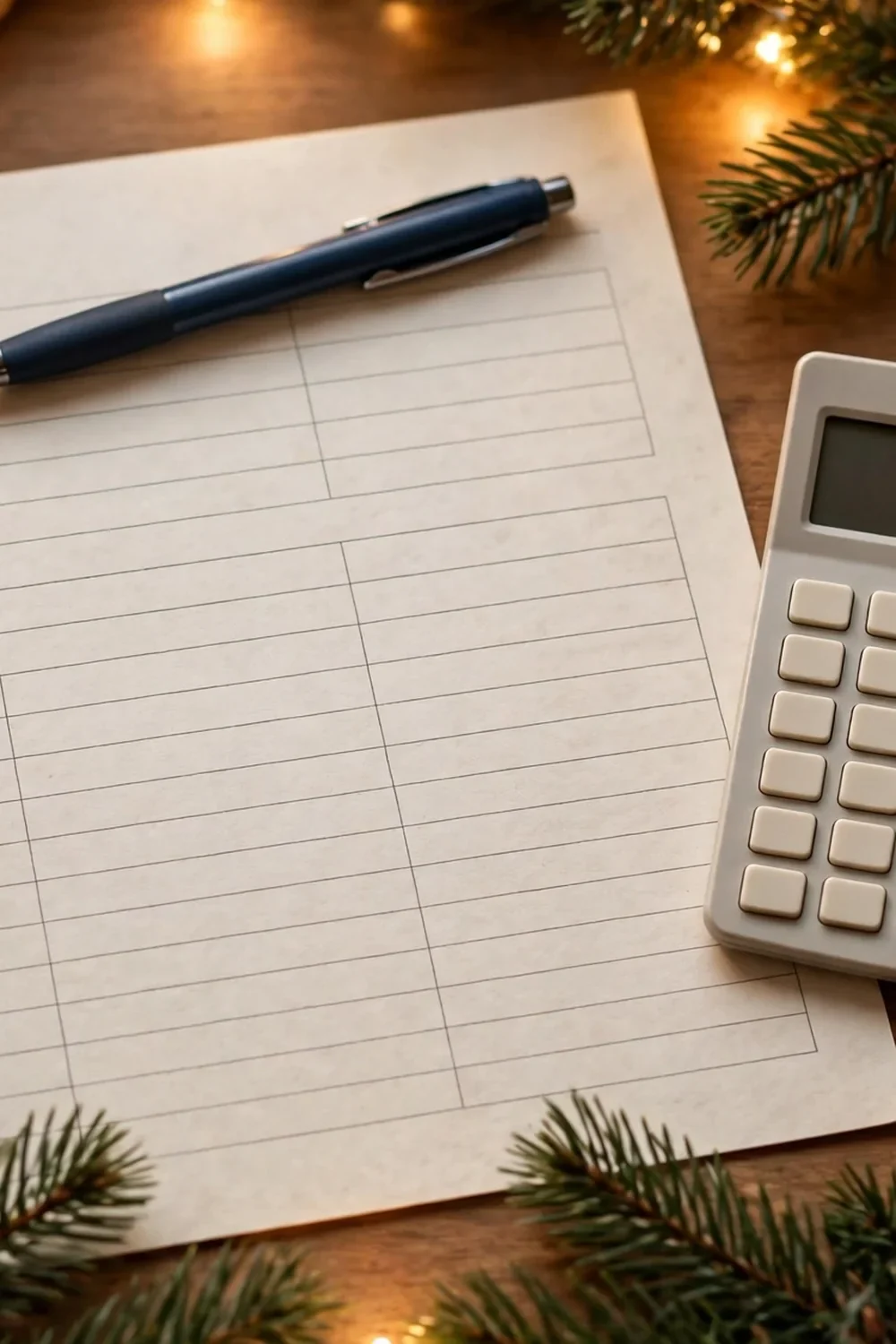
Numbers on paper stop guesswork at the shop. Go down your list, line by line, and write a limit next to each name and each cost. Start with the people who matter most to you, then share what is left across the rest of the list. For example, with an example total of $600 and 10 people on the list, an example gift limit might be $35 for most people and $50 for a parent or a partner. Check the sum of all lines. The sum must match your total, or sit below it.
Track every Christmas budget purchase on one sheet

One sheet beats five notes in five places. Each time you buy a gift, food item, card pack, or decor piece, write the date, the item, and the amount paid on that same sheet. Keep receipts in one folder or envelope, and match them to the sheet at the end of each shopping trip. For example, an example entry might read: December 5, gift for Ana, $32 paid. A clear record shows what is spent, what is left, and what still needs a gift.
Check your running total each week
Small slips grow when no one looks at them for weeks. Pick one day each week, such as Sunday night, and add up what you have spent so far. Compare that sum with your total, and look at each line that sits close to its limit. If a line has room left, note it. If a line sits over its limit, note that too, and plan a fix in the next step. This 10 minute check keeps the plan in view while you still have time to change course.
Heads Up
Do not count a gift as spent when you order it. Count it when you pay for it, so refunds, failed orders, and split payments do not hide the true total.
Shift money between lines when a line runs high
When one line runs high, another line can cover it, but only if you move the money on paper first. Pick a line with room left, lower its limit by the amount you need, and raise the high line by that same amount. For example, if an example gift line runs $15 over its limit, you might lower an example decor line by $15. Write both changes on the sheet, and check that the total stays the same. Never raise one line without lowering another, or the total will drift up without you noticing.
Review your final total after Christmas Day
Your finished sheet holds the full story for next year. Add up all spending, compare it with your first total, and circle the lines that went over and the lines that had room left. Write 3 short notes: what cost more than you planned, what cost less, and what you would change next year. Keep the sheet in a folder or a photo on your phone. That record turns one season of hard choices into a calmer start next December.
Troubleshooting
| If This Happens | Try This |
|---|---|
| You forgot a person on the list | Add the name, give the line a limit, and lower another line by the same amount. |
| A gift costs more than its limit | Move money from a line with room left, and write both changes on the sheet. |
| Receipts pile up and the sheet falls behind | Set a 10 minute catch-up time, match each receipt to a line, and file the receipts at once. |
| Travel plans change late in December | Update the travel line first, then shift money to or from food and gift lines as needed. |
Frequently Asked Questions
When should I start this plan?
Start as soon as you know your December bills. An early start gives you time to set limits, shop with care, and fix slips before the last week.
What if I have no money left after bills?
Set a total of zero for gifts that need cash, and plan gifts that cost time, such as a meal, a letter, or help with a task. Bills and rent come first.
Should gifts and food share one line?
No. Keep gifts, food, travel, cards, and decor on separate lines, so you can see which cost runs high and shift money with care.
What do I do if I go over my total?
Stop new gift spending, look for lines with room left, and move money on paper. If no line has room, trim a future gift or food line before you buy more.
Quick Reference Card
You need: pen and paper or a spreadsheet, bank app or statements, December bills list, calendar, calculator, and a folder for receipts.
Steps:
- Choose one total amount for the season
- List every person on your gift list
- Add food, travel, cards, and decor to the list
- Assign a spending limit to each line
- Track every Christmas budget purchase on one sheet
- Check your running total each week
- Shift money between lines when a line runs high
- Review your final total after Christmas Day
You now have one sheet, one total, and a clear record of each gift and cost. Your plan held through shops, meals, and travel, because you made the hard choices early, on paper.
Keep the sheet for next year. It will make the next start calmer and faster.
Save this guide, and use it when you start your next Christmas plan.