



You have probably heard “no gain without pain” in a gym, a changing room, or a motivational speech. It sounds convincing because it links effort with results. But taken literally, it is poor fitness advice. Progress can involve challenge and temporary discomfort; it should not require you to ignore pain.
The useful version of the saying is simple: improvement asks for consistent effort, sensible progression, and enough recovery. Soreness may happen after a new workout, but it is neither a target nor proof that the session worked.
What Does No Gain Without Pain Mean?
No gain without pain is an expression meaning that worthwhile results usually require effort, patience, or sacrifice. Outside fitness, the “pain” is often figurative: the frustration of learning a skill, the discipline of practising, or the inconvenience of changing a habit.
Inside the gym, however, the wording can be misleading. Effort and pain are not synonyms. A challenging set, faster breathing, or tired muscles can be expected during exercise. Sharp, sudden, worsening, or persistent pain is a reason to stop and assess what is happening.
Where Did the Saying Come From?
The connection between effort and reward is centuries old. English poet Robert Herrick used the line “No pains, no gains” in the 17th century. Much later, “no pain, no gain” became strongly associated with the fitness culture of the 1980s, including Jane Fonda’s workout programmes.
The slogan survived because its motivational message is memorable. The problem begins when people treat it as a medical rule rather than a figure of speech.
Is No Pain, No Gain True in Fitness?
Only in the broad sense that training needs effort. You can improve strength, endurance, mobility, or skill without finishing every workout in pain. What drives progress is an appropriate training stimulus repeated over time.
For strength training, this is often discussed as progressive overload: gradually making an exercise more demanding as your body adapts. That can mean adding a little weight, completing an extra repetition, improving technique, increasing range of motion, or training more consistently. It does not mean making the biggest possible jump every week.
The CDC advises people to start slowly and build towards longer or more intense activity. That steady approach is less dramatic than chasing pain, but it is much easier to sustain.
What Is DOMS?
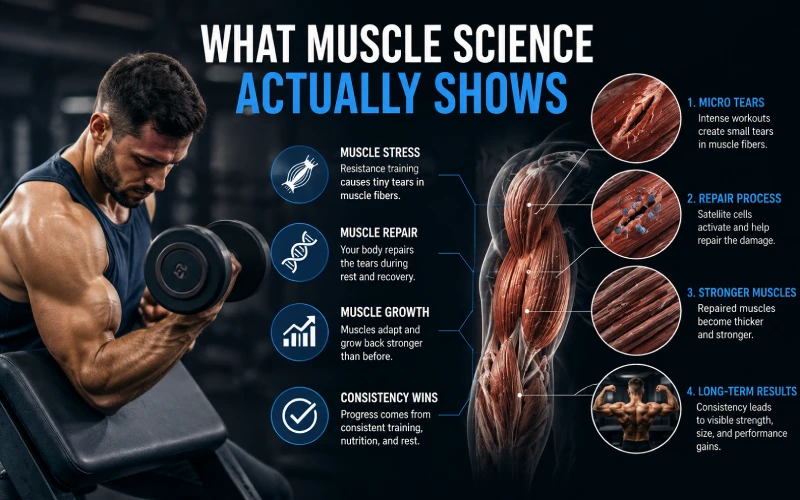
Delayed onset muscle soreness (DOMS) is the ache or stiffness that can appear after unfamiliar or demanding exercise. It is usually felt later rather than at the exact moment of injury, often becoming noticeable the following day.
DOMS is common when you try a new movement, return after time away, or increase the challenge of a workout. It may make the worked muscles tender or stiff for a few days. It is not necessary for muscle growth, and the absence of soreness does not mean your workout failed.
An NHS Foundation Trust guide distinguishes next-day muscle soreness from sharp pain during exercise. The practical lesson is to judge a workout by your form, progression, recovery, and long-term results—not by how difficult it is to walk the next morning.
Normal Effort, Soreness, or a Warning Sign?
| What you notice | What it may mean | Sensible response |
|---|---|---|
| Muscles feel challenged and your breathing increases | Normal exertion for the activity | Slow down if your form or control begins to break down |
| A general ache in the muscles a day or two after a new workout | Possible DOMS | Reduce intensity if needed and allow time to recover |
| Sharp or sudden pain during a movement | Possible injury or irritation | Stop the movement rather than pushing through it |
| Significant swelling, bruising, numbness, or loss of movement | A warning sign that needs attention | Seek appropriate medical advice |
| Pain that keeps returning or is getting worse | The activity or training load may not be suitable | Pause and speak to a qualified health professional |
These descriptions are general guidance, not a diagnosis. The NHS advises runners not to continue running through pain and explains when common exercise injuries should be assessed.
How to Make Progress Without Chasing Pain
Increase the challenge gradually
Change one part of your training at a time. A small increase in weight, duration, repetitions, or difficulty gives you a clearer idea of how your body responds. The CDC likewise recommends starting slowly and progressing to more challenging activity over time.
Use effort as a guide
A rating of perceived exertion, or RPE, is a simple way to describe how hard an activity feels. The right effort depends on your goal and experience. Not every session has to be all-out; easier sessions can help build skill, consistency, and aerobic fitness.
Protect your technique
Fatigue can change how you move. If you cannot keep control or maintain a suitable range of motion, reduce the resistance, shorten the session, or stop the set. More repetitions are not automatically better when form is falling apart.
Make recovery part of the plan
Adaptation happens between sessions as well as during them. Sleep, rest, adequate food, hydration, and a realistic schedule all affect how ready you feel to train again. Recovery needs vary, so an arbitrary rest or “deload” timetable will not suit everyone.
Do not ignore warning signs
According to the NHS guidance on sprains and strains, worsening pain, substantial swelling or bruising, difficulty bearing weight, or a problem that is not improving are reasons to get medical help. Sudden severe pain or emergency symptoms require urgent care.
Does No Gain Without Pain Apply Outside Exercise?
As a metaphor, it can. Learning, changing careers, and building a new routine often feel uncomfortable because they require attention and repetition. But suffering is not a reliable measure of progress in those areas either.
Productive challenge has a purpose and can be followed by recovery. Chronic stress, sleep deprivation, or burnout can reduce performance rather than improve it. A better rule is: accept useful effort, adjust when the cost becomes harmful, and focus on actions you can repeat.
Frequently Asked Questions
Can you build muscle without feeling sore?
Yes. Soreness can occur after unfamiliar exercise, but it is not required for muscle growth or strength improvement. Track performance, technique, and gradual progression instead.
Should I exercise when I have DOMS?
Light movement may feel comfortable when soreness is mild, but a hard session for the same muscles may not be useful if movement or technique is restricted. Reduce the load, choose another activity, or rest according to how you feel.
Is burning during exercise the same as injury pain?
No. A temporary burning sensation in working muscles can accompany hard effort, while sharp, sudden, localised, or worsening pain may signal a problem. Stop if you are unsure or cannot move normally.
What is progressive overload?
It is the gradual increase of a training demand as your body adapts. It can involve resistance, repetitions, duration, frequency, movement quality, or range of motion. Gradual is the important word.
When should exercise pain be checked?
Seek professional advice if pain is severe, keeps returning, worsens, affects normal movement, or comes with notable swelling, bruising, weakness, or numbness. Use urgent medical services for sudden severe pain or other emergency symptoms.
The Bottom Line
“No gain without pain” works better as a reminder that progress takes effort than as a workout instruction. You do not need to chase soreness, ignore joint pain, or train through warning signs to improve.
A safer formula is appropriate challenge, gradual progression, consistent practice, and recovery. Mild post-exercise soreness can happen. Pain that is sharp, worsening, persistent, or affecting normal movement deserves attention. Train with purpose—not simply to hurt.
This article provides general lifestyle information and is not a substitute for individual medical advice.