
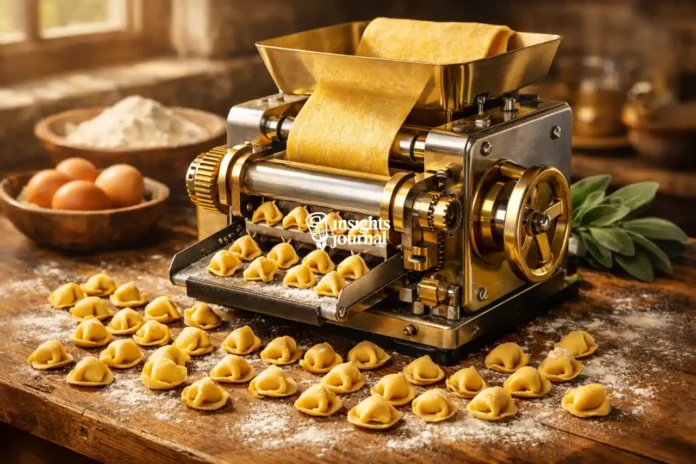


Featured Snippet: A tortellinatrice is a specialized Italian pasta machine that automates the production of tortellini. It rolls pasta dough to 0.6–0.8 mm thickness, portions the filling precisely, folds the dough into the classic ring shape, seals each piece, and ejects it cleanly. Models range from manual home units to industrial systems producing over 400 kg per hour.
Walk into any serious pasta kitchen in Emilia-Romagna and you will likely find one machine doing the work of five pairs of hands. That machine is the tortellinatrice. It takes the most labor-intensive step in Italian pasta-making and turns it into a repeatable, consistent process that runs in minutes rather than hours.
Tortellini have been hand-shaped since the 13th century. Skilled pasta makers known as sfogline spent years perfecting the fold. Beautiful as that tradition is, modern demand changed the equation. A restaurant serving 200 covers a night cannot rely on hand-folding alone. Neither can a pasta shop producing fresh product every morning. The tortellinatrice bridges that gap without sacrificing the shape, texture, or quality that makes tortellini special.
This guide covers everything you need to know: how the machine works, which type fits your situation, what features matter most, how to get clean results every session, and how to maintain your machine for years of reliable use. Whether you are a home cook curious about the technology or a small business owner ready to invest, you will find clear, practical answers here.
What Exactly Is a Tortellinatrice?
The word tortellinatrice translates directly from Italian as “tortellini maker.” That name is precise. Unlike a general pasta roller or a ravioli press, this machine is built specifically around the geometry of stuffed ring-shaped pasta.
At its core, the machine performs four tasks in sequence:
- Dough rolling — Pasta sheets are fed into calibrated rollers that flatten them to a consistent thickness, typically between 0.6 and 0.8 mm.
- Filling portioning — A dosing mechanism deposits exact amounts of filling at regular intervals. This prevents bursting from overfill and hollow centers from underfill.
- Folding and sealing — Guides wrap the dough over the filling, form the ring shape, and apply pressure along the seam. A clean seal here is critical. It protects the filling, keeps the pasta buoyant during cooking, and ensures a clean presentation.
- Cutting and ejection — Cutters separate each piece and eject it onto a tray, conveyor, or collection bin.
The entire sequence happens continuously. Once the machine is fed with dough and filling, it runs until you stop it.
Historically, a skilled sfoglina could shape 50 to 100 tortellini per hour by hand. A modern tortellinatrice produces the same quantity in a matter of minutes. Industrial models reach outputs exceeding 400 kg per hour.
How the Machine Works Step by Step
Dough Preparation Comes First
The machine does not mix or knead dough. You prepare fresh pasta dough separately using flour and eggs, let it rest, then roll it into sheets before feeding it in. Most machines work with sheets that are already at an intermediate thickness, using the machine’s internal rollers for final calibration.
Slightly elastic dough performs better than very soft dough. Overly wet or slack dough tears under the rollers and fails to seal properly. If your first batch produces broken pieces or open seams, dough consistency is usually the first thing to adjust.
Filling Must Be the Right Texture
The filling goes into a hopper or reservoir on the machine. Calibrated nozzles or a rotary piston system deposit it onto the dough at set intervals. The most common mistake beginners make is using filling that is too wet. Excess moisture weakens the seal. A filling with the right consistency, whether that is ricotta and spinach, a classic meat blend, or aged Parmigiano, should hold its shape when you scoop it with a spoon.
Most machines let you adjust the filling volume per piece. That flexibility matters when you switch between tortellini and the larger tortelloni, or when recipe changes require a different dough-to-filling ratio.
Sealing Pressure Determines Quality
After the dough wraps around the filling and forms the ring, the machine applies sealing pressure at the edges. The seal needs to be firm enough to hold through cooking but not so aggressive that it crushes the filling or tears thin dough. Better machines let you fine-tune this pressure. Once you find the right setting for your dough recipe, save it. Consistent settings across shifts keep quality stable.
Types of Tortellinatrice: Which One Fits You?
| Type | Best For | Output | Price Range |
|---|---|---|---|
| Manual (hand-crank) | Home cooks, small batches | Low | Budget-friendly |
| Semi-automatic | Artisan shops, small restaurants | Medium | Mid-range |
| Fully automatic | Commercial kitchens, pasta labs | High | Significant investment |
| Industrial | Factories, mass production | Very high (400+ kg/hr) | Premium |
Manual Models
Manual tortellinatrici use a hand-crank mechanism. They are compact, affordable, and easy to store. You control the speed and feel the dough as it moves through. For households that make tortellini a few times a month, or for culinary enthusiasts who want speed without losing the handmade feel, a manual machine is a practical choice.
The trade-off is output. Manual machines work well for batches of a few dozen to a few hundred pieces. They are not suited to daily commercial production.
Semi-Automatic Models
Semi-automatic machines automate the filling and sealing but may still require manual dough feeding or some hand adjustments. They produce significantly more than manual models while staying within a budget that small pasta shops and restaurant kitchens can justify. Many chefs prefer this type because it keeps them in the process while removing the most repetitive steps.
Fully Automatic and Industrial Models
Fully automatic machines handle every step from dough feeding to ejection. The operator loads materials, sets the parameters, and monitors the output. Industrial versions run continuously, often with programmable settings, touchscreen controls, and sensors that reject misshapen pieces before they reach packaging.
Large-scale industrial machines can process 12,000 pieces per hour or more. These systems are built for factories and large-scale distributors, with stainless steel frames, industrial motors, and interchangeable molds that switch between tortellini, tortelloni, cappelletti, and even some dumpling shapes.
Key Features to Look For Before Buying
Not every tortellinatrice is built the same. These are the features that separate reliable machines from frustrating ones.
Food-grade stainless steel construction is the baseline standard for any machine used in a food environment. Look for clean seams and minimal crevices. Bacteria colonize rough surfaces and tight gaps. Simple, smooth internal pathways clean faster and last longer.
Adjustable filling control gives you flexibility across recipes. Fixed portioning locks you into one filling volume, which is a problem when your menu changes.
Interchangeable molds let one machine produce different pasta shapes. If you plan to add tortelloni or cappelletti to your offering, confirm that compatible molds are available and easy to swap.
Disassembly for cleaning should take under 15 minutes. Machines that require tools or long teardown times slow down your workflow and tempt staff to skip proper cleaning. Dough residue hardens quickly and degrades performance.
Safety certifications matter for commercial kitchens. In Europe, look for CE marking. In markets where NSF or HACCP compliance is required, verify the machine meets those standards before purchase.
Spare parts availability is often overlooked. A machine with no local parts support is a liability. Ask the supplier about lead times and stocking before signing anything.
Getting the Best Results from Your Machine
Good results start before you switch the machine on. Rest your dough for at least 30 minutes after kneading. This relaxes the gluten and prevents tearing. Roll it to an intermediate thickness before feeding, then let the machine’s rollers do the final calibration.
Clean the machine after every session. Even a small amount of dried dough left on the rollers or in the mold will affect the next batch. Residue causes uneven dough thickness and irregular sealing. For storage periods longer than a month, apply a thin coat of food-grade mineral oil to exposed metal components.
When you start a new batch, run the first few pieces slowly. Check the seal by pressing the edge gently. If it opens without resistance, the sealing pressure needs adjustment. If the dough tears at the fold, the sheets may be too thin or the dough too dry.
Most operators find that the learning curve is around two days of regular use before production runs smoothly and consistently.
Who Uses a Tortellinatrice?
The machine serves a wide range of users. Fresh pasta laboratories use it daily to supply retail and restaurant accounts. Restaurants and trattorias use compact or semi-automatic models to keep fresh tortellini on the menu without the labor cost of hand-shaping. Supermarket deli counters use higher-output models to meet consistent daily demand.
Small artisan pasta makers use mid-range machines to stay competitive with larger producers without losing the handmade character of their product. Culinary schools use them to teach students both the traditional technique and the modern production reality.
FAQs About the Tortellinatrice
Can a tortellinatrice make shapes other than tortellini? Yes. Most machines accept interchangeable molds for tortelloni, cappelletti, agnolotti, and some Asian-style dumplings. Confirm mold availability with the manufacturer before purchase.
Does machine-made tortellini taste different from handmade? Taste depends on dough quality and filling recipe, not the shaping method. Both produce delicious results when made with good ingredients.
What filling types work in a tortellinatrice? Meat, cheese, vegetable, and mixed fillings all work. The filling must have a smooth, consistent texture and not be overly wet.
How much does a tortellinatrice cost? Manual home models start at a few hundred dollars. Semi-automatic units for small businesses range from several hundred to a few thousand. Industrial machines can reach tens of thousands.
How often should I clean the machine? After every use. Dried dough degrades performance quickly. A full deep clean every few months keeps all components in good condition.
Making the Right Investment
Choosing a tortellinatrice comes down to three honest questions: How much pasta do you need to produce? How often will the machine run? And what level of after-sales support is available in your area?
A home cook making tortellini twice a month does not need a semi-automatic machine. A restaurant serving fresh pasta daily cannot rely on a manual crank. The machine should match where your production realistically stands in six months, not where you hope it might be. Buying too much capacity is a waste. Buying too little means you will be shopping again within a year.
Ask for a demonstration before purchasing any commercial model. Run your own dough and filling through it. Check how long disassembly takes. Look at the quality of the ejected pieces. Talk to other operators using the same machine. A tortellinatrice is a meaningful investment and a machine you will use every working day. Make that decision with your eyes fully open.
The tortellinatrice does not replace the skill of the pasta maker. It preserves the result while handling the repetition. The dough recipe, the filling quality, the attention to detail — those still come from you. What the machine gives you is time, consistency, and the ability to scale without sacrificing either.