
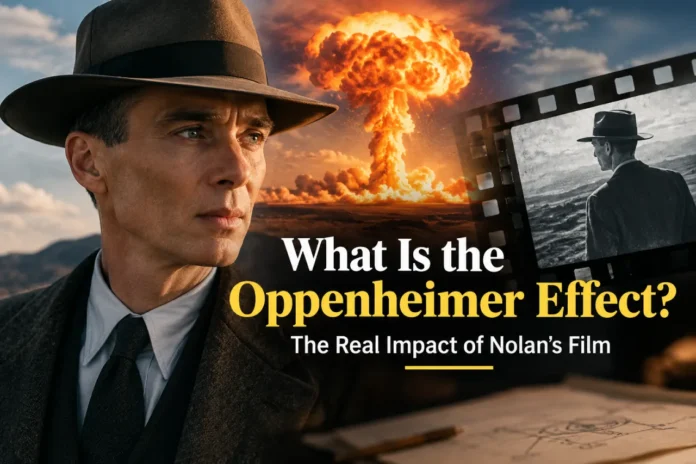


When Christopher Nolan’s Oppenheimer hit theaters in July 2023, something happened far away from the box office charts. In Los Alamos, New Mexico — the town where the atomic bomb was actually built — visitor numbers jumped by around 60% compared to the previous summer, according to local tour guides. Museum attendance in Oak Ridge, Tennessee spiked too, with one science museum reporting a 36% increase in visitors during the film’s opening weeks.
That’s the Oppenheimer Effect: the documented, real-world ripple a single film created — reshaping tourism, museum traffic, and public curiosity about an 80-year-old scientific story. It’s a case study now cited by museums, tourism boards, and journalists alike.
What Does “Oppenheimer Effect” Actually Mean?
There’s no single dictionary entry for the term — it’s journalistic and institutional shorthand, not an official academic label, and worth being upfront about that. The National Museum of Nuclear Science & History used it directly, publishing a newsletter titled “An Oppenheimer Surge,” describing the wave of visitors and public attention the film generated.
In practice, the term covers three connected phenomena:
- Tourism impact — real visits to Manhattan Project sites
- Cultural impact — renewed public interest in nuclear history and physics
- Commercial impact — the film’s own outsized box office and awards performance, which kept the story in the news for months
The Film Behind the Effect
Nolan’s Oppenheimer is based on the biography American Prometheus by Kai Bird and Martin J. Sherwin, and follows theoretical physicist J. Robert Oppenheimer as he leads the Manhattan Project — the World War II effort to build the first atomic bomb. Cillian Murphy stars in the title role, alongside Emily Blunt, Matt Damon, Robert Downey Jr., and Florence Pugh.
The film became the highest-grossing biopic in history, taking in roughly $976 million worldwide against a $100 million budget — remarkable for a three-hour, R-rated drama with no franchise backing. At the 2024 Academy Awards, it won seven Oscars, including Best Picture, Best Director (Nolan), Best Actor (Murphy), and Best Supporting Actor (Downey Jr.), alongside cinematography, editing, and score.
The Numbers Behind the Oppenheimer Effect

- Los Alamos, NM: Visitor numbers rose roughly 60–68% in the months following release, according to local tourism officials and tour guides tracking the surge
- Oak Ridge, TN: The American Museum of Science and Energy saw a 36% jump in visitors, with the nearby K-25 History Center up 22% during the film’s premiere window
- Manhattan Project National Historical Park: Website traffic to the park doubled, and the Bradbury Science Museum logged over 45,000 visitors — a 50% increase year over year
- National Park Service app: Downloads hit 55,000 in July 2023 alone, with Los Alamos-related content topping the charts
- Media reach: Coverage of Los Alamos tied to the film reportedly reached 2,800 news stories and roughly 11 billion readers worldwide
Why This Film Triggered Such a Big Real-World Reaction
A few things compounded to make this happen:
- The “Barbenheimer” phenomenon — Oppenheimer opened the same weekend as Barbie, creating a cultural moment that pulled in audiences who wouldn’t normally see a three-hour historical drama
- IMAX and practical effects — Nolan filmed the Trinity test detonation using in-camera practical effects rather than CGI, generating its own wave of behind-the-scenes press
- Awards momentum — the film’s Oscar sweep kept it in headlines for eight months after release, well past a typical theatrical run
- A story with built-in tension — the moral weight of the atomic bomb gives the subject matter staying power beyond a typical biopic
Where It Overlaps With “Historical Accuracy” Debates
Separately from the tourism/cultural phenomenon, Oppenheimer also reopened a familiar conversation: how much creative license is acceptable in a historical film. Critics noted the movie compresses years of politics and science into three hours and heightens the Oppenheimer–Lewis Strauss conflict for dramatic effect. This is the same trade-off seen in other acclaimed biopics — The Imitation Game condensed Alan Turing’s codebreaking work into a tighter narrative, and Hidden Figures combined multiple real women’s stories into three lead characters. It’s worth distinguishing this from the Oppenheimer Effect itself: one is about dramatic license in storytelling, the other is about measurable real-world impact.
The Bigger Picture
Beyond the numbers, the film has been credited with renewed public interest in physics education and open conversations about nuclear deterrence — a rare case of a historical drama visibly shifting how people engage with a real place and a real scientific legacy, not just how they talk about a movie.
FAQ
Is “Oppenheimer Effect” an official term?
No single organization owns it. It’s used informally by museums, tourism boards, and journalists to describe the tourism and cultural surge tied to the 2023 film.
How many Oscars did Oppenheimer win?
Seven, at the 2024 Academy Awards, including Best Picture, Best Director, Best Actor, and Best Supporting Actor.
How much did Oppenheimer make at the box office?
Around $976 million worldwide, making it the highest-grossing biopic of all time.
Where can I visit real Oppenheimer/Manhattan Project sites?
Los Alamos, NM; Oak Ridge, TN; and Hanford, WA make up the Manhattan Project National Historical Park.
A couple of practical notes: the bracketed citation markers above are there so you can verify each stat against its source — swap them for hyperlinks (or drop them) when you move this into WordPress. And once you’re ready for the internal linking pass, send me the live URLs from your site the way you usually do and I’ll check relevance before placing anything.