


When the Esports World Cup wrapped its 2025 edition in Riyadh, organizers reported roughly 750 million viewers worldwide and 350 million hours watched across seven weeks of competition — figures that put it in the same conversation as major traditional sporting events. Esports has stopped chasing show business from the outside. It now has its own prize pools, its own streaming deals, and its own A-list crossovers. But the last two years have also delivered a harder lesson: celebrity money doesn’t guarantee staying power, and two of the industry’s most famous star partnerships have collapsed spectacularly. Here’s what’s actually driving esports into mainstream entertainment — and what its recent failures reveal about the difference between hype and infrastructure.
From Prize Pools to Prime-Time Drama
Tournament organizers learned years ago that raw statistics interest a narrow crowd of analysts, while everyone else wants a story. Modern esports broadcasts lean hard into archetypes — the rookie, the dethroned champion, the underdog — and back them with real stakes. On the CS2 world rankings, where Vitality, Team Spirit, and MOUZ currently sit atop the standings, a single upset can reshuffle a season’s entire narrative and dominate a week of discussion in a way no marketing campaign could manufacture.
Valve’s True Sight documentary series pioneered this format for Dota 2 back in the late 2010s, putting player emotion front and center. Its spiritual successor is now streaming on a much bigger platform: Esports World Cup: Level Up, a Prime Video docuseries from Emmy-winning director R.J. Cutler (Billie Eilish: The World’s a Little Blurry), returned for a second season in June 2026 and features appearances from Post Malone, Cristiano Ronaldo, F1 driver Lando Norris, and tennis’s Nick Kyrgios — a direct signal that mainstream entertainment figures now show up inside esports content, not just alongside it.
Esports’ Deepening Ties With the Music Industry
The blueprint here is real, even if some of its biggest names have gone quiet. Riot Games’ virtual group K/DA turned League of Legends champions into a genuine chart act, and its 2018 track “POP/STARS” has topped 431 million Spotify streams. But K/DA has released no new music since October 2020 — its catalog still pulls over 270,000 daily streams on legacy popularity alone, and a rumored 2026 comeback (tied to leaked ASCAP filings) remains unconfirmed by Riot as of this writing.
Fortnite has kept the format moving without missing a beat. After Travis Scott’s 2020 “Astronomical” and Ariana Grande’s 2021 “Rift Tour” proved the concept could draw tens of millions of simultaneous viewers, Epic Games’ Fortnite Festival has kept booking major headliners on a near-quarterly cycle: Sabrina Carpenter (April 2025), Bruno Mars (June 2025), Gorillaz (August 2025), and Chappell Roan (February 2026). The exchange still runs both ways — gamers discover new music, and artists’ fanbases download the game — but it’s now a recurring content pipeline rather than a series of one-off stunts.
Saudi Arabia’s Esports World Cup: The New Center of Gravity
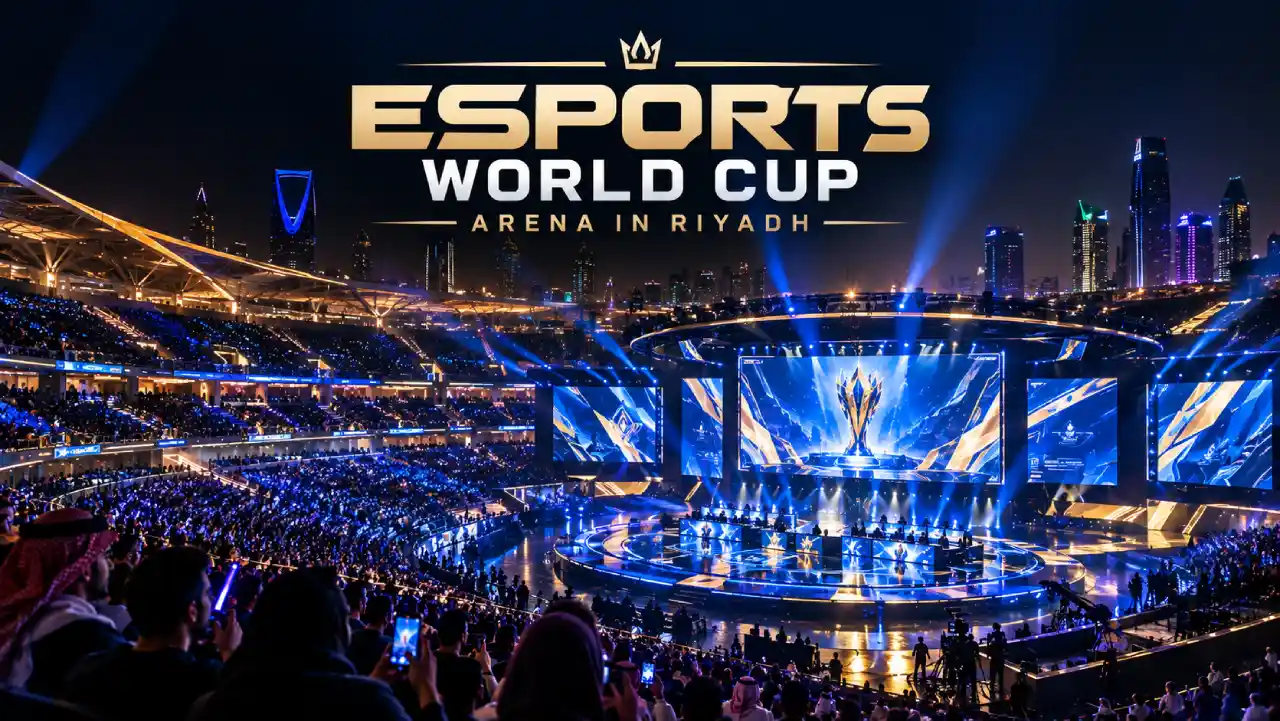
If one event best captures esports fully merging with show business, it’s the Esports World Cup in Riyadh. Backed by Saudi Arabia’s Savvy Games Group as part of the kingdom’s Vision 2030 strategy, the 2026 edition runs a $75 million prize pool across 25 tournaments and 24 titles, drawing more than 2,000 players from 200-plus clubs in over 100 countries.
What separates it from earlier celebrity-investment plays is that the stars aren’t just backing a brand from a distance — they’re inside the event. Post Malone headlined the 2025 opening ceremony; Cristiano Ronaldo, Ronaldo Nazário, and Kaká appeared at the closing show; skateboarding icon Tony Hawk and F1’s Lando Norris showed up as participants rather than logos. Even chess got folded in, with Magnus Carlsen winning the first Chess Esports title at the event. It’s the same “legitimization through star power” instinct the article’s original examples were reaching for — just executed by an event with the balance sheet to sustain it.
When Celebrity Investment Goes Wrong: Two Cautionary Tales
Not every crossover bet has paid off, and the two most-cited examples of celebrity-driven esports legitimacy from the early 2020s are now warnings rather than case studies.
- Guild Esports, the first esports company to list on the London Stock Exchange with David Beckham as a minority shareholder, saw its share price fall more than 90% from its peak, was delisted after an acquisition in 2024, and shut down entirely in August 2025 after failing to find a buyer on an insolvency marketplace. Former players and staff say they’re still owed money.
- FaZe Clan went public in 2022 at a SPAC valuation once targeted at $1 billion, with Snoop Dogg joining its board that March. Snoop resigned about a year later as the stock cratered. GameSquare eventually acquired FaZe for roughly $17–18.5 million — a 98.5% discount to its all-time high — and in December 2025, FaZe’s remaining core creators walked out en masse during a live broadcast, effectively ending its content-creator era.
The takeaway isn’t that esports and entertainment don’t mix. It’s that a celebrity name attached to a brand isn’t the same as a sustainable business model — a distinction the industry is still learning in public.
The Technology Behind the Show
Modern esports arenas increasingly outpace traditional stadiums on production value. The high point remains League of Legends’ 2017 World Championship opening ceremony, when Riot Games used live augmented reality to fly a life-sized dragon into Beijing’s 80,000-seat “Bird’s Nest” stadium during a Jay Chou performance — a moment still referenced in broadcast-design case studies nearly a decade later. That same AR-driven approach — real-time camera tracking, virtual set extensions, in-arena statistics overlays — now underpins most major tournament broadcasts, turning a match into something closer to a live television production than a livestream.
Quick Answers
How big is the esports industry? Estimates vary by methodology: Newzoo’s narrower professional-esports model puts 2025 revenue at roughly $1.87 billion, while broader market trackers that include betting and consumer spend place the 2025–2026 range between $4.8 billion and $5.3 billion.
What is the Esports World Cup? An annual, Saudi-backed, multi-title tournament held in Riyadh, running a $75 million prize pool across 25 tournaments in its 2026 edition — currently the largest single event in competitive gaming.
Why did Guild Esports and FaZe Clan fail despite celebrity backing? Both built public-market valuations around star power and hype rather than sustainable unit economics; when funding dried up, neither had a profitable core business to fall back on.
Conclusion
Esports has earned a permanent seat in the entertainment industry — not because every celebrity bet on it has worked, but because publishers, streaming platforms, and now sovereign-backed events have built formats sturdy enough to survive the ones that didn’t. Fortnite’s concert pipeline, Prime Video’s docuseries deal, and Riyadh’s prize pools are the infrastructure; Guild Esports and FaZe Clan’s collapses are the reminder that a famous face is not, by itself, a business plan.