
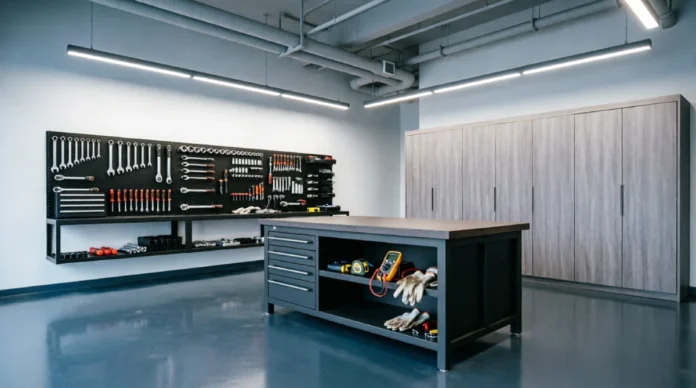


The first consideration for a renovation is determining how much power to dedicate to the garage and how you will benefit from it most effectively and efficiently.
An excellent place to start is to find out what a qualified electric car charging station installer would suggest.
Auditing and upgrading the electrical panel
Before splurging on shelving brackets and garage flooring kits, call in an electrician to size up your service panel. A 100-amp service is standard in most homes with more than 15 years on the clock. It’s entirely adequate for the average household’s demands: the fridge, laundry room appliances, and the AC. Toss in a Level 2 charger for your EV, and suddenly, you’ve exceeded the amperage capacity of the main service.
A 200-amp service upgrade is the standard for EV-ready homes, and it makes good sense; it provides ample headroom to accommodate a 240V circuit for the charger without overtaxing the system. The charger itself will use a NEMA 14-50 receptacle, also found on ranges, allowing for flexible installation without hard-wiring the charger into the circuit.
In addition to the convenience aspect, the National Fire Protection Association notes that electrical distribution and lighting equipment are the leading cause of structure fires in the home garage. Circuits that are undersized, shared, or improperly installed are prevalent contributing factors.
Your electrical panel upgrade and 240V circuit should be installed by a licensed professional. This step and all others relating to the 240V circuit should not be taken on by unlicensed individuals.
Strategic location of the charging station
Once the size and scope of your electrical upgrade have been decided upon, you must consider where you will place your charger. This consideration is not as simple as picking the most accessible place along the wall nearest the panel. The location where you store and use your EV will dictate where you need to install the charger. EV charging stations use a wide variety of ports, some of which are located at the front or rear of the vehicle, or on the driver’s side. A charging station that is too far away from the parking bay will either cause an eyesore of excess cable on the floor or make every charge frustrating.
Consider installing the unit near the entrance to the garage or, for those with two-car garages, centrally located between parking spaces. The entrance option will allow the most flexibility for different parking arrangements and is sometimes the only option for “curbside” charging in the driveway in addition to everyday charging. The second option provides flexibility without limiting driveways or entrances.
Cable management in relation to the charger is also a necessity. Heavy-duty charging cables strewn across the floor are a tripping hazard that can also incur damage from foot traffic or vehicles. Retractable reels, wall mounts, and overhead storage are all excellent ways to store and organize your charging cable. The overall objective is to keep the cable out of the way when not in use and within easy reach when it is needed.
Climate control, insulation, and battery management
Batteries maintain peak performance within a comfortable temperature range. Extreme temperatures during the charging session reduce the efficiency of the battery, negatively affecting the driving range of the vehicle. A garage that reaches 40 degrees Celsius in the summer or near freezing in the winter is not only uncomfortable but unhealthy for the car’s battery.
Your vehicle’s battery management system will actively work to negate the effects of extreme temperatures, but that places additional strain on the vehicle to keep the battery at an optimal state of charge. If you would like to reduce this strain and prolong the life of your vehicle’s battery, consider insulating the space where it will be stored for long periods of time.
Insulating the walls will reduce the amount of heat that enters or exits the space, assisting in maintaining a stable temperature within the garage. However, if your garage door is the largest source of heat gain or loss, you may find yourself right back where you started.
Regardless of climate, or if your region only sees a couple of degrees of difference between seasons, the garage door is the most substantial surface within your home’s envelope, capable of massive heat transfer through convection. As such, its selection can be one of the most vital steps in any garage build. In addition to security and aesthetics, garage doors Adelaide should be chosen with thermal performance in mind. Providing the same level of insulation as you have for the walls and ceiling will ensure continued climate stability throughout the year and keep temperatures well within the comfort range for you and your car. The value of the insulation will be seen year-round, not just in the winter or summer.
Garage ventilation is another area of concern, particularly in relation to vehicle batteries. While an internal combustion engine produces significantly more waste heat than an EV battery, a closed-up garage without any form of passive or active ventilation can allow the temperature to rise throughout the night, especially with a slow, overnight charge. Installing vented soffits or a small exhaust fan will allow cooler outdoor air to enter the space while simultaneously removing stale air.
Flooring suitable for the weight of your vehicle
Your car is undoubtedly heavier than the gasoline-powered vehicle you may have owned previously. This presents an issue for many garage owners: how to maintain a lasting, quality-looking floor without damage caused by the vehicle’s weight. However, that is where the increased weight is deceptive; while a mid-size EV may weigh anywhere between 300-700 kilograms (680-1,543 lbs) more than a petrol counterpart, most of that weight is distributed at the front of the car.
This distribution pattern is done intentionally, and it is the reason why batteries are stored on the lower front section of the car; the increased ground pressure across the front wheels is spread over a larger surface area. By doing so, the stress exerted on the floor is reduced by as much as 50%.
Older concrete, however, is not as resistant to ground pressures or as durable as one may think. Part of the reason for this is the natural function of concrete: to expel trapped moisture. Trapped moisture occurs when the ground beneath the slab is warmer than the slab itself, which can frequently happen when a heavier vehicle is parked on it. As such, vehicles will cause concrete to weaken, especially in areas where their weight is distributed unevenly. The worst offenders are tires, which can reach temperatures as high as 60 degrees Celsius (140 degrees Fahrenheit) when hot. Placing such objects on concrete that has not been reinforced or prepared correctly can result in delamination or cracking and is often the reason for failure in older concrete.
Additionally, oils and chemicals may seep into the concrete, causing it to erode, and localized wear from warm tires can further hasten the process.
However, standard concrete is an acceptable subfloor material, provided that it is sealed with a low-maintenance top layer. Polyaspartic coatings are a fantastic option for residential garages. They possess exceptional adhesive qualities, providing a strong connection to the subfloor and are highly resistant to abrasion, impact, and UV light degradation. Another benefit is that they cure at a faster rate than epoxy coatings, which also lends itself to less downtime for installation. In terms of curing, the primary concern when preparing a residential-grade garage floor is ensuring that the coating is applied to a properly prepared surface. This involves grinding, repairing cracks, and testing for moisture levels in the slab. Neglecting these steps will lead to coating failure.
Proper lighting for the space
A single-bulb or dual-tube fluorescent fixture is fine for guiding traffic in and out of the garage. However, if you plan on using the garage for any other purpose in addition to pulling in your car, this level of illumination is wholly inadequate. The addition of LED lighting in a zoned configuration can transform the space from a dark hole into something much more useful. The first consideration is ambient, or overhead, lighting.
This configuration allows for overall functionality of the space. Task lighting comes second and focuses primarily on areas of the garage that you will use the most, such as work benches or a dedicated workspace. The third consideration is the addition of lighting near or over the charger, or the installation of motion-sensing switches in that area. You should not have to fumble blindly for a light switch every evening when you return from work.
LED lighting uses significantly less energy than halogen, incandescent, or even fluorescent sources. This benefit is incredibly important when considering the addition of an EV charger to the space. The energy saved by making the switch can be exponentially increased by the energy saved through the use of a 240V circuit.
Storing vehicles, equipment, and materials vertically
The floor is a precious commodity in an EV-ready garage. Whether it is to allow for unimpeded access to the vehicle, provide a clear path of travel for the charger, prevent clutter buildup, or simply to give the eye a more spacious appearance, floor-standing cabinets are an incredibly poor choice. It is far too easy to sacrifice square footage in favor of storage space when the alternative is to make the most of the space you have by organizing vertically.
A slatwall organizational system mounted to the wall provides flexible, modular storage without the use of any floor space. The rest of your storage needs in the garage can be accommodated by ceiling storage systems, which make use of otherwise wasted overhead space. Between the two, you can store an astonishing amount of your personal effects without taking up any floor space.
Not only does this provide more space, but it also ensures that the path to your EV is clear at all times. Similarly, the space between the charger and vehicle is free of obstacles, including emergency egress pathways if you ever need to leave the garage quickly. Lastly, it ensures that no wall-mounted switches or the 240V circuit are blocked from view, giving you much-needed peace of mind.
Electrical conduits and smart systems
If you are renovating your existing garage, you may not be considering a second EV for several years. Take this opportunity to install empty conduits in the wall while you have access to them. Running an extra circuit from the panel to a second bank of outlets will be considerably less expensive at this stage. Doing so afterward will be much more complicated and costly, assuming you can even fit the conduit in the wall.
The same considerations apply to conduits for solar battery storage, which many homeowners choose to incorporate within several years of acquiring an EV. Taking advantage of the empty conduits will allow you to maximize your system’s capabilities without paying for the privilege several years down the line.
Smart home systems allow you to connect and control all aspects of your home on a single interface. In the context of a garage renovation, this means linking the smart garage door opener to the rest of the system, which controls lighting, ventilation, and perhaps even the EV charger itself. The practical application of such a system is found in the ability to schedule the EV charger to begin its slow, off-peak charge.
It also ensures that the garage door is always closed and provides an easy way to confirm that your vehicle is, in fact, plugged in without having to enter the garage. Modern smart EV chargers also possess load-balancing technology that ensures that the charger, and by extension the vehicle, is not using the full capacity of the circuit at the same time as other electrically-intensive devices in the home.
Designing your garage around its intended use
The modern home garage is arguably the most technically advanced room in any house. High-value possessions are kept within, alongside equipment that places high power demands on the house electrical system. Vehicle charging infrastructure is installed, with complex and technical systems to maintain and power them.
These vehicles often require climate control to support their continued performance and longevity over time. The garage is also almost certainly required to provide a stable climate daily while also being subjected to the whims of the weather through a large overhead door. Lastly, it serves as a place of transit, with people passing through the space multiple times a day.
With all of these requirements, the one thing a garage should never be is unsafe. Designing the space around these factors and remembering to work from electrical systems through to finishings will allow you to get the most from your garage.