


At some point, most growing businesses hit the same wall. Orders are increasing, suppliers are further away, and the informal arrangements that worked fine when volumes were low are starting to strain. Someone’s cousin with a van is not a logistics strategy. Neither is paying for a full dedicated vehicle every time you need to move twenty boxes of stock.
This is where pallet delivery services start to make real commercial sense. Palletised freight is the standard method for moving commercial goods at scale across the UK and into Europe. It is structured, traceable, cost-effective for a wide range of consignment sizes, and available to businesses of almost any size. Understanding how it works and what to look for in a provider can save money, reduce damage rates, and give you much better control over where your goods are and when they will arrive.
What Pallet Delivery Actually Involves
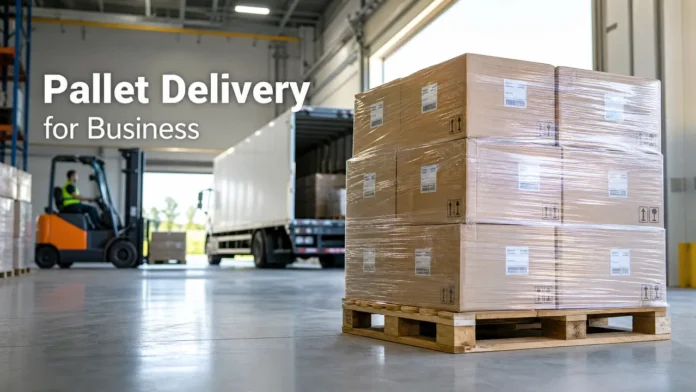
When freight is described as palletised, it means the goods have been secured onto a standard wooden pallet and wrapped or strapped ready for transport. The pallet becomes the unit of measurement for the journey. Carriers quote by pallet space, not by item count, which makes pricing much more predictable than courier arrangements where every parcel is individually rated.
A standard UK pallet measures 1,200mm by 1,000mm and can carry up to 1,200kg at full height. Half pallets carry up to 500kg, quarter pallets up to 250kg. These are not arbitrary numbers. They correspond to the equipment used throughout the supply chain: forklift dimensions, warehouse racking systems, the width of trailer decks. When your consignment is built to these specifications, it slots into the logistics network without friction.
For businesses, the practical advantage is that you can move substantial quantities of goods in a single shipment without needing a dedicated vehicle. A pallet of 500kg of stock is the same price per kilo to move as a single 25kg parcel if you are using the right service. Often considerably less.
Economy vs Express: Choosing the Right Speed
One of the most useful features of palletised freight networks is the ability to choose your speed. That choice has a direct effect on cost, and getting it right matters for businesses managing tight margins.
Next-day delivery within the UK is available for time-critical consignments. This is the right option when a customer is waiting, a production line is standing, or a deadline is firm. It costs more than economy options, and the extra cost is usually justified in those circumstances.
Economy services, typically 48 hours for most UK mainland destinations, cost less and are entirely adequate for the majority of non-urgent commercial shipments. If you are restocking warehouse inventory, sending goods to a distributor, or shipping to a customer who has no specific time pressure, there is little reason to pay express rates.
Scottish Highlands, offshore locations and some more remote areas take longer regardless of which service tier you choose, usually three to five days. Worth knowing before you commit to a delivery window with a customer.
For European freight, options vary by route and destination, but 48 to 72 hours to major European hubs is typical for express services, with economy options running to around five working days. The ability to choose between these tiers depending on what each shipment requires is something a good freight provider will help you think through, not simply default you to the most expensive option.
How Palletised Freight Protects Your Goods
Damage in transit is a real cost for businesses. A broken item means a replacement or a refund, a customer complaint, and often a returns process that costs almost as much as the original shipment. Multiply that across a busy month, and the numbers become significant.
Palletised freight reduces damage risk in a few specific ways. Goods are secured and consolidated onto a rigid platform rather than being handled individually at every stage of the journey. Stretch wrapping and strapping keep the load stable. The pallet is handled by forklift or pallet truck rather than by hand, which means less incidental contact with the goods themselves.
The loading process matters too. A well-loaded pallet, with heavier items at the base, goods stacked within the pallet footprint rather than overhanging, and adequate wrapping at the top and sides, travels significantly better than one that has been thrown together quickly. Most freight providers will give you guidance on this before your first shipment. Follow it. The few minutes it takes to load correctly pays back quickly in reduced claims.
According to Logistics UK (formerly the Freight Transport Association), damage to goods in transit is one of the most common and avoidable costs in commercial logistics, with poor packaging and load preparation cited as a primary cause. Pallet-based shipping with proper preparation addresses most of those risk factors directly.
National Coverage and Why It Matters for Growing Businesses
A business that operates nationally needs logistics that can keep up. One of the advantages of using an established pallet network is access to coverage you could not build yourself. Rather than managing relationships with multiple regional carriers, you deal with one provider who can reach any mainland UK postcode and most European destinations.
For businesses that are growing geographically, this is particularly useful. When you win your first customer in Scotland, or your first B2B client in Germany, you do not want to spend two weeks finding a carrier who can serve that route. If your pallet provider covers it, you simply add the destination to an existing relationship and keep moving.
Coverage is not just about geography. It also means consistent service standards regardless of where the delivery is going. The same tracking, the same proof of delivery, the same process for raising a query if something goes wrong. Inconsistency across regions is a common frustration for businesses using a patchwork of different carriers, and palletised networks largely eliminate it.
Tracking and Visibility in Practice
Ten years ago, checking where a freight shipment was involved a phone call and some uncertainty. Now, most pallet networks offer online booking, real-time tracking, estimated arrival windows and electronic proof of delivery as standard.
For a business managing multiple consignments at once, this visibility is genuinely valuable. You can confirm to a customer that their order has left your premises, is currently in transit, and is due for delivery between 10am and noon tomorrow. That is a qualitatively different customer experience from saying it should be with you by the end of the week.
Electronic proof of delivery also closes the loop on disputes. If a customer claims a delivery never arrived, you have a timestamped record with the recipient’s signature or a photograph of the delivered pallet. For B2B businesses where invoice disputes can slow down cash flow, this kind of documentation has real administrative value.
The Cost Argument for Smaller Businesses
There is a common assumption that palletised freight is for large businesses with high volumes. It is not. The structure of pallet networks means that a business sending a single pallet a week has access to the same infrastructure and largely the same rates as one sending fifty.
The pricing model works on pallet spaces, not volume commitments. A quarter pallet of goods weighing 80kg will cost a fraction of a full pallet, but it travels through the same network, with the same tracking, to the same destinations. For small businesses that need to ship goods professionally but cannot justify dedicated vehicles or high-volume contracts, this is exactly the right model.
Groupage services extend this further. If your consignment does not fill a pallet, your goods can be consolidated with other cargo heading in the same direction. You pay only for the space you use. For businesses that ship irregularly or in small quantities, groupage is often the most cost-effective option available.
What to Look for in a Pallet Delivery Provider
Not all pallet services are the same. The network they operate within, their customer service approach, and their experience with commercial freight all vary considerably.
Membership of an established pallet network matters. Networks like Palletways operate across the UK and Europe with hub-and-spoke infrastructure, overnight consolidation and consistent service standards. A carrier that plugs into a network of this kind can offer much broader coverage and more reliable transit times than one operating independently.
Customer service quality is harder to measure in advance but makes a significant difference day to day. When a consignment is delayed, when you need to amend a delivery address at short notice, or when a pallet arrives with minor damage and you need to raise a claim, the ease of that conversation determines how much time you lose. A provider with a direct phone line, experienced staff, and a clear process for problem resolution is worth paying a small premium for over one that handles issues through an automated system.
Ask about track records with businesses similar to yours in size and sector. A provider with genuine B2B experience understands that commercial deliveries have specific requirements: booking-in processes at distribution centres, restricted delivery hours at some business premises, the need to coordinate with a recipient rather than simply leave a card. These details separate a provider that actually works for business use from one that has adapted a consumer-facing model with a commercial label on it.
The businesses that manage logistics most efficiently are usually those that treat freight as a deliberate decision rather than an afterthought. Getting the right pallet provider in place early saves significant time and money as you grow.