


Staying connected while traveling is no longer just about checking messages. Travelers rely on mobile data for maps, ride-hailing apps, hotel bookings, boarding passes, translation tools, restaurant searches, and keeping in touch with family.
That is why eSIMs have become one of the most useful travel tools for international trips.
Instead of finding a SIM shop after landing or removing the tiny SIM card already inside your phone, an eSIM lets you add a mobile plan digitally. Depending on your phone, destination, and provider, you may even be able to buy and install a travel data plan before leaving home.
eSIM adoption is also growing quickly. GSMA reported that eSIM accounted for around 5% of global smartphone connections at the end of 2025 and projected that figure to reach around 10% by the end of 2026.
For travelers, however, the real appeal is much simpler: less hassle when getting connected abroad.
What Is an eSIM?
An eSIM, or embedded SIM, is a digital version of the SIM technology used to connect a phone to a mobile network.
Unlike a traditional SIM card, you do not usually have to insert or remove a physical card. Instead, an eSIM profile is downloaded to a compatible device.
The GSMA describes eSIM as a way of securely downloading SIM functionality into a secure element built into a device.
Depending on your device and carrier, activation may happen through:
- A QR code
- A carrier app
- An activation link
- Automatic carrier activation
- Your phone’s mobile network settings
This can be especially convenient when traveling internationally.
Why eSIMs Are So Useful for International Travel
1. You Can Get Connected Without Hunting for a SIM Shop
One of the biggest advantages of an eSIM for travel is convenience.
With a physical SIM, travelers may need to find an airport kiosk, mobile phone shop, or local carrier after arriving.
With many travel eSIM services, you can purchase a plan before your flight, install the eSIM while you still have reliable Wi-Fi, and activate the plan when you reach your destination.
That can mean having mobile data available shortly after landing.
2. You Can Keep Your Main SIM Active
Many modern phones support more than one SIM profile.
This can allow you to keep your regular mobile number active while using a travel eSIM for data.
For example, you might:
- Keep your home number available for calls or verification messages
- Use a travel eSIM for mobile data
- Choose which SIM handles calls, texts, and internet access
Google notes that supported Pixel devices can store multiple eSIM profiles, while some newer models can use two eSIM profiles at the same time if the carrier supports the feature.
The exact options depend on your phone model and carrier.
3. Travel eSIMs Can Help You Avoid Expensive Roaming
International roaming from your normal carrier can sometimes be convenient, but it may also be expensive depending on the destination and plan.
A prepaid travel eSIM gives you another option.
Instead of automatically relying on your home carrier’s roaming rates, you can compare:
- Data allowance
- Plan duration
- Destination coverage
- Network availability
- Hotspot support
- Speed restrictions
- Total price
Google specifically recommends considering a prepaid eSIM from an international carrier when traveling to help avoid roaming charges.
That does not mean an eSIM will always be cheaper. In some destinations, a local physical SIM or your carrier’s roaming package may offer better value.
The advantage is having another option to compare.
4. You Can Choose Plans Before You Travel
Travel planning is easier when connectivity is sorted before departure.
Many eSIM providers let you browse country-specific, regional, or global plans online.
For example, a traveler visiting several European countries may prefer a regional plan instead of buying a separate SIM in each destination.
Someone taking a short trip to Japan may prefer a country-specific data package.
This flexibility makes eSIM particularly useful for:
- Multi-country holidays
- Business trips
- Digital nomads
- Frequent flyers
- Weekend city breaks
- Backpacking trips
Apple says worldwide eSIM service providers now offer plans covering more than 190 countries and regions, although availability and compatibility vary by provider and device.
5. No Tiny SIM Card to Lose
Physical SIM cards are small.
Very small.
Anyone who has switched SIM cards in an airport, hotel room, or café knows how easy it is to misplace one.
Because an eSIM profile is stored digitally on the device, there is no physical travel SIM to keep track of.
You also do not need to carry:
- A SIM ejector tool
- Multiple SIM cards
- Small SIM adapters
- A container for your home SIM
It is a small convenience, but during a busy trip, small conveniences matter.
6. Switching Between Plans Can Be Easier
Frequent travelers may accumulate several mobile plans over time.
Compatible phones can store multiple eSIM profiles, allowing travelers to manage different networks from their phone settings instead of physically replacing cards.
For example, you might have:
- Your regular home SIM
- A European travel eSIM
- A Japan travel eSIM
- A work line
You would not necessarily use all of them simultaneously, but having profiles stored digitally can make future trips easier.
eSIM vs Physical SIM for Travel
| Feature | Physical SIM | Travel eSIM |
|---|---|---|
| Installation | Insert card manually | Usually installed digitally |
| SIM shop required | Often | Usually not |
| Can buy before travel | Sometimes | Often |
| Risk of losing SIM | Yes | No removable card |
| Switching plans | Requires changing SIMs | Usually managed in settings |
| Keep home SIM installed | May be difficult on single-SIM phones | Often possible on dual-SIM devices |
| Availability | Very widespread | Depends on phone, carrier and destination |
Neither option is automatically better in every situation.
The right choice depends on your phone, destination, trip length, data needs, and local pricing.
Are eSIMs More Secure?
eSIMs have one useful physical-security advantage: there is no removable SIM card for someone to simply take out of your device.
Google notes that because an eSIM is embedded in the phone, it is less vulnerable to physical damage than a removable SIM.
However, using an eSIM does not make your phone immune to:
- Phishing
- Account takeover
- Weak passwords
- Malware
- Unsafe public Wi-Fi
- Online scams
Travelers should still use normal mobile-security precautions.
What to Check Before Buying a Travel eSIM
Before purchasing an eSIM, confirm a few important details.
Is Your Phone eSIM Compatible?
Not every smartphone supports eSIM.
Support varies by:
- Brand
- Model
- Country where the phone was purchased
- Carrier
- Device generation
For example, Google states that Pixel 4 and later phones support eSIM, although carrier and regional restrictions can still apply.
Apple also maintains a list of carriers and international providers that support eSIM services.
Is Your Phone Unlocked?
A carrier-locked phone may prevent you from using an eSIM from another provider.
Check your device’s carrier-lock status before purchasing a travel plan.
Does the Plan Include Calls and Texts?
Many travel eSIM packages are data-only.
That is perfectly fine if you mainly use:
- FaceTime
- Messenger
- Google Maps
- Social media
But travelers who need a local phone number for traditional calls or SMS should check the plan details carefully.
When Does the Plan Start?
Activation rules vary.
Some plans begin when you install the eSIM.
Others start when the phone first connects to a supported network in the destination.
Check this before installation so you do not accidentally start a short-duration plan too early.
Is Tethering or Hotspot Use Allowed?
If you plan to use your phone as a hotspot for a laptop or tablet, check whether tethering is included.
Some plans allow it freely, while others restrict it.
How to Use an eSIM When Traveling
The exact process depends on your device, but it generally looks like this:
- Confirm that your smartphone supports eSIM.
- Make sure the phone is unlocked if required.
- Compare plans for your destination.
- Purchase your preferred eSIM.
- Install the eSIM while connected to reliable Wi-Fi.
- Label the new line something obvious such as “Travel Data.”
- Keep your normal SIM as your primary voice line if needed.
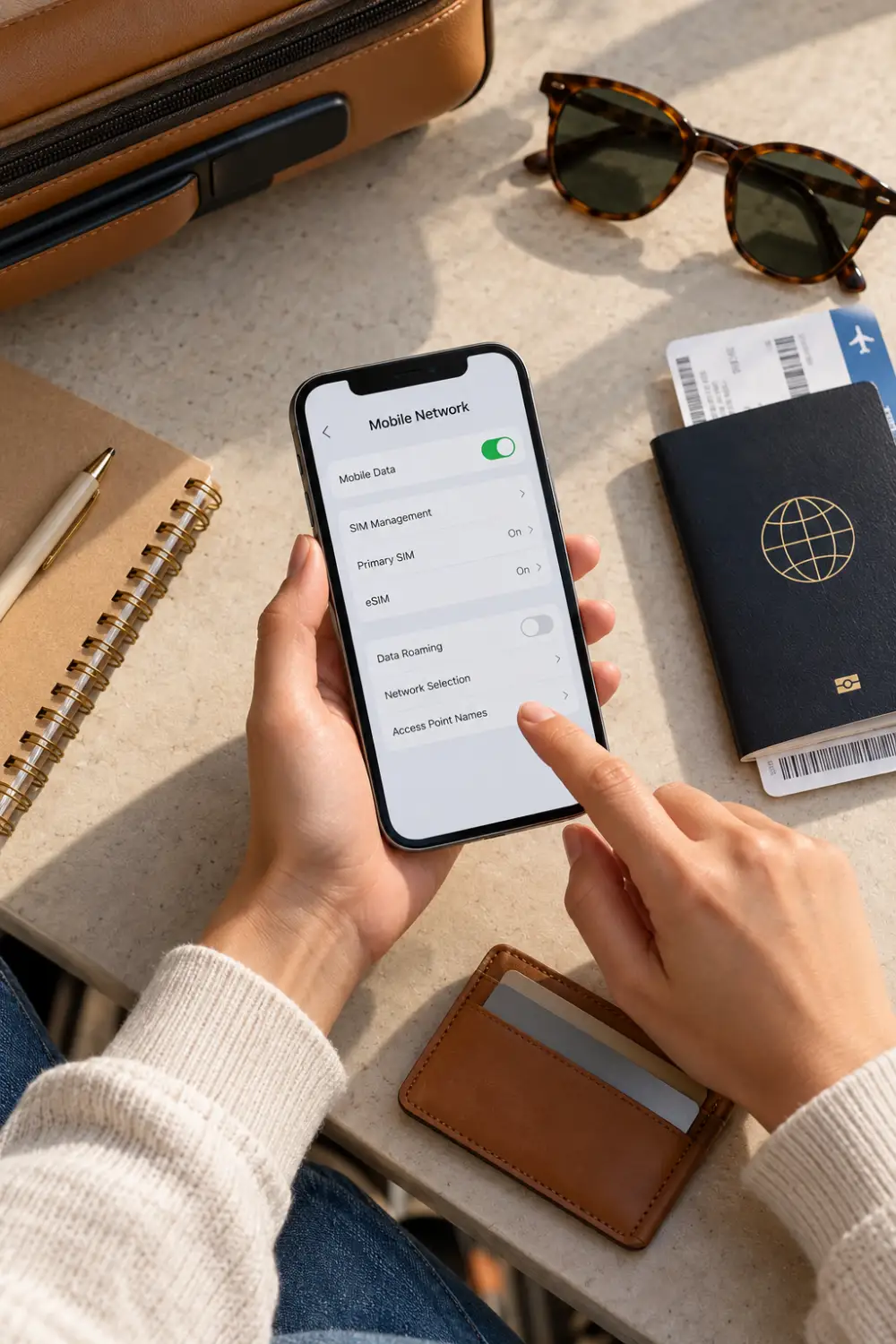
- Select the travel eSIM for mobile data.
- Turn on data roaming for the travel eSIM if the provider requires it.
- Avoid enabling roaming on your home SIM unless your normal carrier plan includes it.
Whenever possible, install the eSIM before arriving at your destination.
That way, if there is an activation issue, you can solve it before you urgently need mobile data.
When a Physical SIM May Still Be Better
eSIM is convenient, but it is not always the best choice.
A physical local SIM may make more sense when:
- Your phone does not support eSIM
- Local SIM cards are significantly cheaper
- You need a local phone number
- You are staying for several months
- The local carrier provides better coverage
- Your phone is locked to another network
Some travelers also prefer their home carrier’s roaming package because it requires almost no setup.
The best approach is to compare all three options:
Travel eSIM vs local SIM vs international roaming.
Are eSIMs Worth It for Travel?
For many international travelers, yes — mainly because of convenience.
You can potentially arrange mobile data before departure, keep your regular SIM installed, avoid searching for a SIM shop after landing, and switch between digital plans without handling tiny cards.
But an eSIM is not automatically the cheapest or fastest choice everywhere.
Before purchasing one, compare coverage, data allowance, validity period, hotspot rules, and total cost with local SIM cards and your carrier’s roaming packages.
Final Thoughts
Travel has become increasingly dependent on mobile connectivity, and eSIM technology removes some of the friction that traditionally came with staying online abroad.
You may be able to step off the plane with maps, messaging, booking apps, and ride-hailing services ready to use — without visiting a mobile shop first.
That makes an eSIM less of a flashy travel gadget and more of a practical planning tool.
Before your next international trip, check whether your phone supports eSIM, compare the available plans, and install your chosen option before departure.
A few minutes of preparation at home can make staying connected abroad much easier.