
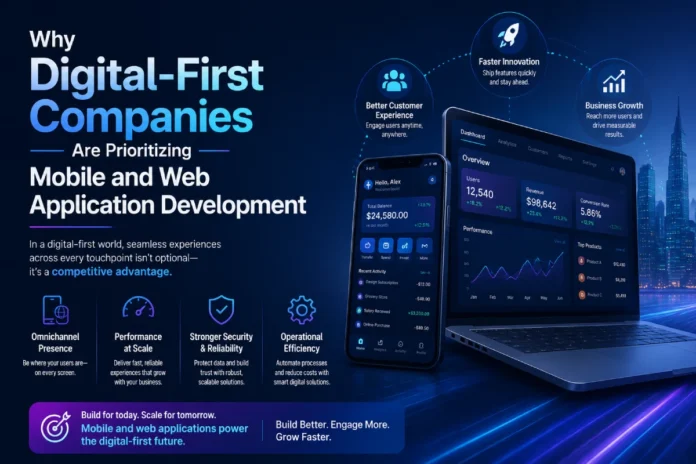

A digital-first company does not treat technology as a support function. It treats software as the product, the storefront, the service desk, and the relationship with the customer all at once. For these businesses, the application is not a representation of the company. In many cases, it is the company. That shift in mindset is reshaping where leaders choose to invest, and increasingly, the answer is custom mobile and web application development.
The reasoning is practical. Customers now expect to interact with a brand through fast, intuitive, always-available digital experiences. A clunky interface or a slow load time is no longer a minor inconvenience. It is a reason to leave and choose a competitor. For companies built around digital channels, the quality of their applications directly determines revenue, retention, and reputation.
This is why so many forward-looking organizations are moving away from generic, templated tools. Purpose-built custom web application development services allow a business to design experiences around its own users and workflows rather than squeezing operations into software that was built for someone else. The web application becomes a tailored asset that reflects how the company actually works and what its customers actually need.
The same expectation now extends across every screen. As more interactions move to phones and tablets, mobile is rarely an afterthought for a digital-first brand. It is often the primary channel. Investing in custom mobile application development services gives companies control over performance, design, and functionality on the devices their customers use most, instead of settling for a stripped-down version of the desktop experience.
Together, web and mobile form the foundation of a digital-first strategy. Understanding why leaders are prioritizing both, and how to do it well, is essential for any organization that intends to compete on customer experience.
The Rise of the Digital-First Business Model
Digital-first is more than a buzzword. It describes a fundamental reordering of priorities. In a traditional model, technology serves the business processes that already exist. In a digital-first model, the digital experience comes first, and the business is built to deliver it.
This shift has been accelerating for years, driven by changing customer behavior, the maturity of cloud infrastructure, and the competitive advantage that well-designed software provides. Companies that embraced digital channels early discovered they could reach customers more efficiently, gather richer data, and iterate faster than slower-moving rivals.
For these organizations, mobile and web applications are not cost centers to minimize. They are growth engines to invest in. Every improvement in speed, usability, or reliability translates fairly directly into business outcomes, which is why digital-first leaders treat application development as a strategic priority rather than a technical chore.
Why Web Applications Remain a Core Investment
Even in a mobile-heavy world, web applications continue to carry significant weight. They serve as the central hub for many businesses, supporting everything from customer portals and dashboards to internal operations and partner integrations.
Web applications offer a level of accessibility that is hard to match. They run in a browser, require no installation, and reach users across devices and operating systems. For complex workflows, large interfaces, and data-rich experiences, the web often remains the most practical environment.
Custom web development matters here because off-the-shelf platforms tend to impose their own structure on a business. A tailored web application, by contrast, is shaped around the company’s specific processes, branding, and goals. It can integrate cleanly with existing systems, scale as demand grows, and evolve as the business changes. For digital-first companies, this flexibility is the difference between software that enables growth and software that quietly limits it.
Why Mobile Has Become Non-Negotiable
Mobile usage has reshaped how people interact with brands. Customers research, purchase, communicate, and manage their lives from their phones, often expecting to do so at any hour and from any location. For a digital-first company, a strong mobile presence is no longer optional.
A well-built mobile application offers advantages that a mobile website cannot fully replicate. It can use device features such as notifications, location, and the camera. It can deliver faster, smoother performance. It can work in low-connectivity conditions and create a more immersive, focused experience that keeps users engaged.
Just as important, a dedicated mobile app signals commitment. It gives the brand a permanent place on the customer’s device and a direct line of communication. For businesses competing on convenience and loyalty, that presence is a meaningful advantage. Custom development ensures the app reflects the brand, performs reliably, and grows alongside the company rather than being constrained by a generic template.
The Strategic Advantages of Building Both
The strongest digital-first companies do not choose between web and mobile. They build both into a unified strategy where each channel reinforces the other.
This combined approach delivers several advantages. It meets customers wherever they are, on whichever device they prefer. It creates a consistent brand experience across touchpoints. It allows data to flow between channels, producing a fuller picture of customer behavior. And it provides resilience, since a business that depends on a single channel is more exposed to disruption than one with multiple strong digital pathways.
A coordinated web and mobile strategy also supports better decision making. When applications are designed to capture and share data, leaders gain clearer insight into how customers engage, where friction occurs, and which features drive value. That insight fuels continuous improvement, which is the engine of long-term digital success.
Common Pitfalls to Avoid
Prioritizing application development is the right instinct, but the way a company executes determines the result. Several pitfalls trip up otherwise capable organizations.
The first is treating mobile and web as separate, disconnected projects. When the two are built in isolation, they often diverge in design and data, creating a fragmented experience and duplicated effort. A unified strategy avoids this.
The second is favoring speed over architecture. Rushing to launch with shortcuts in the underlying structure tends to create technical debt that slows future growth and raises long-term costs.
The third is underestimating the importance of the right development partner. Strong applications require both technical skill and an understanding of business goals. The right partner brings the experience to anticipate challenges, recommend sound architecture, and align the technology with the outcomes a company is trying to achieve. This is where thoughtful consultation pays off, helping leaders make informed choices before significant resources are committed.
A Practical Example
Consider a service company that initially relied on a basic website and a phone-based booking process. As customer expectations shifted, the company found itself losing prospects who wanted to browse, book, and manage appointments digitally, especially on their phones.
The business invested in a custom web application for richer self-service and a dedicated mobile app for on-the-go access. The two shared a common backend, so customer information, bookings, and history stayed in sync across channels. Customers could start an interaction on one device and continue it on another without friction.
The results reflected the investment. Bookings increased as the process became easier, support calls declined as self-service improved, and the company gained valuable data about customer preferences. The applications did not just digitize an existing process. They opened new ways to serve customers and grow the business.
Conclusion
Digital-first companies prioritize mobile and web application development because, for them, the application is the business. Customer experience, operational efficiency, and competitive position all flow through these digital channels, which makes the quality of that software a strategic concern rather than a technical detail.
The lesson for business owners, CTOs, and decision-makers is straightforward. Investing in well-designed, custom web and mobile applications is no longer a luxury reserved for technology giants. It is a practical requirement for any company that wants to meet modern customer expectations and build durable advantage.
The organizations that thrive in the years ahead will be those that treat their applications as living, evolving assets, built with care, aligned to clear goals, and developed with the right expertise. In a digital-first world, that commitment is what separates the brands customers return to from the ones they leave behind.